The Agriculture Trust Ecosystem
Nov 10, 2026
Carlos Faria
Strategist
Supply Chain
Why trusted relationships matter to the future of agriculture. Seed, fertiliser, equipment, finance, insurance and transport all need to come together at the right time, and one broken commitment can compromise an entire season.
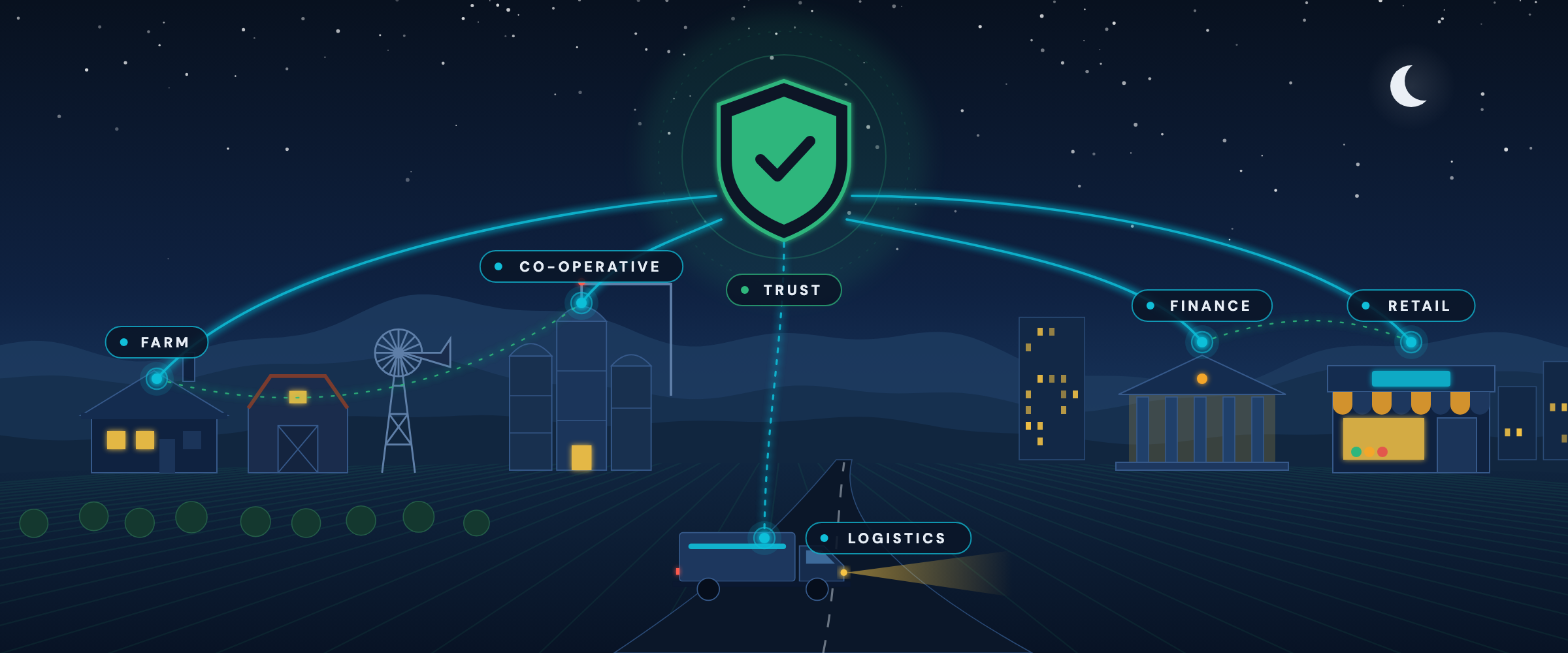
At M2North.com (Trusted B2B Suppliers) we have made trust central to the transaction process. Think about a farmer preparing for planting. Seed, fertiliser, equipment, finance, insurance and transport all need to come together at the right time. One failed delivery or broken commitment can compromise an entire season.
That is why agriculture is about more than buying and selling products. It is a network of relationships, and the quality of those relationships determines how well the system works.
At M2North, we want to strengthen that network through digital connectivity, efficient transactions and better information. We call this the Trust Ecosystem, of which the agriculture sector is an important part.
The real cost of doing business
Two suppliers may quote the same price. One delivers on time, sends accurate invoices and resolves problems quickly. The other creates delays, errors and endless follow-up. Their prices are equal; their value is not.
The same applies to buyers. A customer who communicates clearly and pays on time is easier and less expensive to serve. Trust works both ways. It is not a slogan; it is the result of consistent behaviour.
Digital systems can make these relationships more efficient and, eventually, make performance easier to understand. But the starting point is simple: reduce friction and help people keep their commitments.
Our eight-stage journey
We see the development of the ecosystem as a progression of trusted suppliers and buyers, and not as eight capabilities already completed:
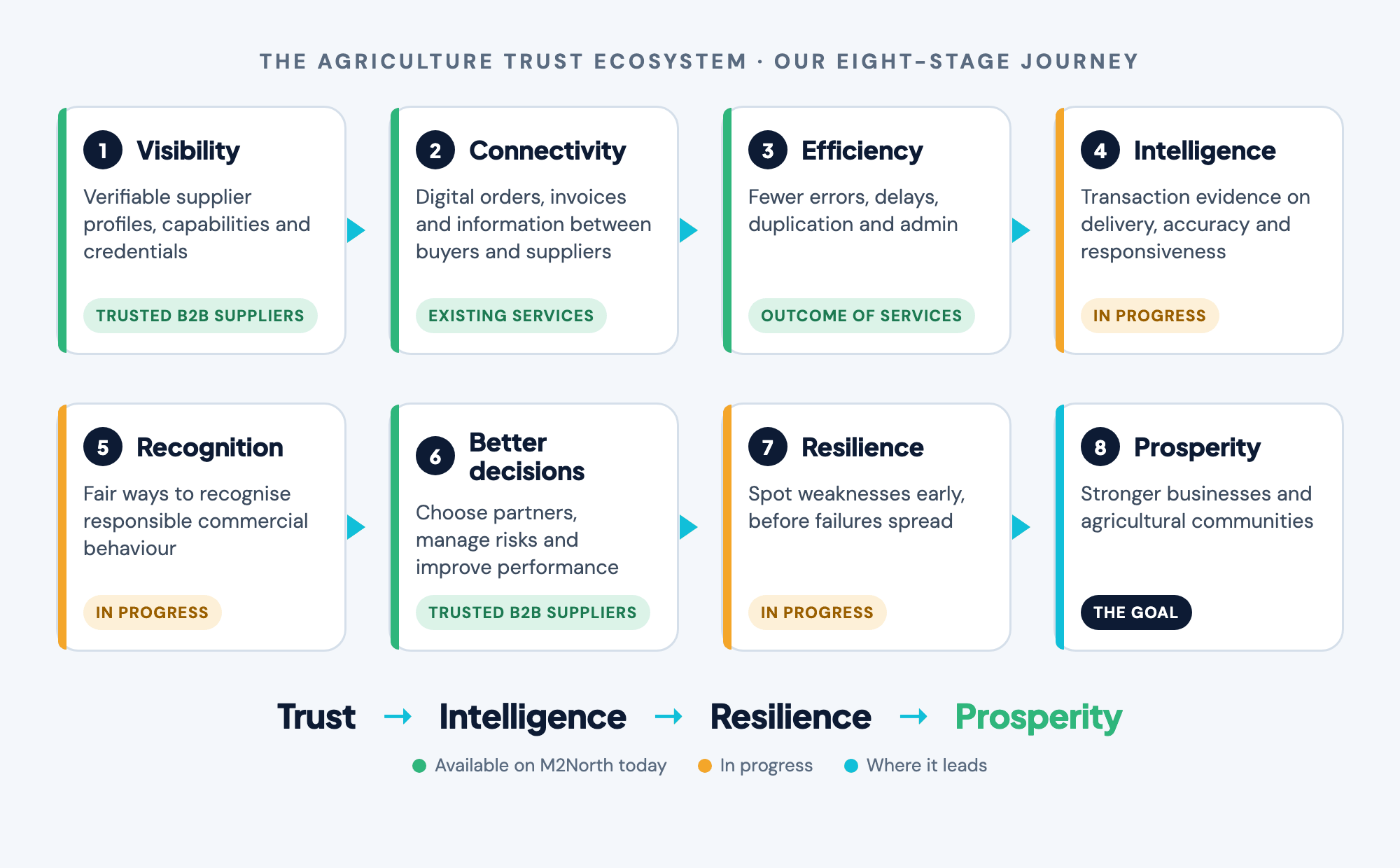
- Visibility — establish useful, verifiable supplier profiles, capabilities and credentials. (Trusted B2B Suppliers on M2North.com)
- Connectivity — connect buyers and suppliers through digital orders, invoices and information. (Existing services)
- Efficiency — reduce errors, delays, duplication and unnecessary administration. (Outcome of implementing M2North services)
- Intelligence — use transaction evidence to understand delivery, accuracy and responsiveness. (In progress)
- Recognition — develop fair ways to recognise consistently responsible commercial behaviour. (In progress)
- Better decisions — help businesses choose partners, manage risks and improve performance. (Trusted B2B Suppliers on M2North.com)
- Resilience — identify weaknesses early and coordinate responses before failures spread. (In progress)
- Prosperity — create stronger businesses and agricultural communities through better relationships.
The direction is straightforward: Trust → Intelligence → Resilience → Prosperity.
What should a Trust Index measure?
A useful Trust Index must help answer a practical question: can I rely on this business to do what it promises?
Potential measures include transaction accuracy, delivery reliability, responsiveness, service quality, digital capability, verified compliance and the quality of ongoing commercial relationships.
But a seed supplier is not a transporter or an insurer. We cannot force every business into one universal score. We must distinguish verified credentials from observed performance and subjective feedback, use relevant benchmarks, protect data and give businesses a fair way to correct mistakes.
Trust cannot be manufactured by an algorithm. It has to be earned, then represented honestly by evidence.
A network, not a straight line
Agriculture connects input suppliers, farmers, cooperatives, processors, logistics providers, financial institutions, exporters, retailers and communities. Many participants are buyers and suppliers at the same time.
M2North's role is to strengthen the connections between them: supplier visibility, electronic transactions, automation and operational information, with evidence-based trust capabilities developed over time.
Better connections matter because a problem in one part of the network rarely stays there.
What buyers and suppliers gain
Buyers need dependable supply, accurate information and a realistic understanding of total procurement costs. Digital processes can reduce manual work and exceptions. Better performance information could eventually help them identify problems earlier and recognise reliable suppliers.
Suppliers need the same practical benefits: clearer orders, fewer invoice disputes, simpler onboarding and less administration across multiple customers. A dependable smaller supplier should have a fair opportunity to demonstrate its capabilities, not be excluded because it has less technology or a shorter track record.
Measure the economics
Trust has economic value, but we must prove it. The cost of a purchase order is not just the time taken to process it. It includes errors, disputes, missing deliveries, delayed payments and the management attention required to put things right.
We should measure transaction accuracy, processing time, exception rates, onboarding time, service performance and cost to serve.
A network that learns
Better digital transactions create better information. Better information can support better decisions. Better decisions can encourage more dependable behaviour, which makes the network more valuable to everyone.
AI could eventually help identify recurring problems, emerging risks and suitable commercial partners. But more data is not automatically better intelligence. The evidence must be reliable, the methods explainable and the decisions accountable to people.
Why agriculture? Why now?
Agriculture combines seasonal pressure, weather uncertainty, capital intensity and complex logistics. Citrus, grain, dairy, livestock and forestry do not operate in identical ways. Our approach must respect those differences while improving the commercial processes they share: orders, deliveries, invoices, payments and problem resolution.
There is also a larger purpose. Farmers steward land, soil, water, animals, capital and livelihoods. Suppliers, buyers, financiers and insurers influence how well those resources are used. A healthier commercial system can support healthier agricultural communities.
M2North cannot remove risk or guarantee prosperity. We can help create the conditions in which businesses work together more effectively and make better-informed decisions.
The ambition
Our ambition is not simply to build a larger transaction network. It is to build a more useful one — a network where reliability is recognised, unnecessary costs fall and better commercial relationships create value for everyone involved.
Connectivity is the beginning. Trust is earned through behaviour. Intelligence helps us learn. Resilience and shared prosperity are the outcomes worth pursuing.
M2North: Connecting businesses. Building trust. Powering prosperity.
Healthy supply chains feed stronger communities.
Agriculture as a Connected Community
Nov 4, 2026
Carlos Faria
Strategist
Supply Chain
The problem in agriculture is not always production. Many losses are failures of coordination, not effort. What changes when information flows back from consumers to farmers, and businesses make better decisions together?
The Adaptive Farm
Nov 4, 2026
Carlos Faria
Strategist
Supply Chain
How better decisions, smarter technology and trusted relationships can strengthen South African agriculture: manage the farm as one connected economic system, improve what already exists, and invest where there is a clear return.
Agriculture: 16% of Suppliers, 80% of Transactions
Nov 10, 2026
Carlos Faria
Strategist
Newsletter
The Trust Index for October 2026: 1,631,786 transactions processed across the network, 86.8% of 47,830 AI-processed pages going straight through, and what the 80/20 split in agriculture means for how you work with suppliers.
Book a demo
See how M2North turns these ideas into practical workflows.